

Determining reasonable compensation for the CEO of a privately held company isn’t as simple as looking at what other CEOs earn. One of the biggest challenges is determining what that same executive would be paid if they had the same skills, experience and responsibilities but did not own the business.
That distinction matters, particularly when evaluating long-term incentives (LTI). Compensation surveys are often used to establish market benchmarks, but many fail to account for how privately held companies actually compensate nonowner CEOs. As a result, the data can significantly understate the long-term incentive compensation that would be appropriate for a nonowner outsider.
The courts have recognized this distinction for years. Understanding the concept—and the limitations of conventional compensation surveys—is essential when evaluating reasonable compensation in private company litigation matters.
Establishing the Nonowner Outsider Standard
CalCPA performed a valuable service in In re Marriage of Rosen, 105 Cal.App.4th 808 (Cal. App. Dec. 24, 2002). Crediting CalCPA, the court stated:
“reasonable compensation may also be based upon ‘the cost of hiring a nonowner outsider to perform the same average amount that other people are normally compensated for performing similar services’”—the “similarly situated professional” standard [emphasis added].
The term “nonowner outsider” gave a name to an approach that had been used for years in other reasonable compensation litigation matters, particularly the “disguised dividend” cases frequently brought by the IRS.
The distinction is especially important when looking at compensation practices among closely held businesses.
Understanding CEO Compensation in Closely Held Businesses
The most predominant form of private company ownership is the sole proprietorship, often operating as a single-member LLC. The IRS puts this category at more than 70 percent of all business tax returns filed. Other common structures include partnerships and S Corporations. C Corporations account for less than 5 percent, most of which are public companies. Thus, more than 95 percent of private business filers are pass-through entities.
CPAs can attest that most private companies are closely held, either by the head of the business—the “CEO”—or the CEO’s family.
Compensation consultants generally frame reasonable compensation around three components: salary, short-term incentives (bonuses) and long-term incentives (LTI). LTI is intended to reward and encourage long-term company success. It can take the form of stock, but for tax reasons, private companies more often use phantom stock or payments deferred until a liquidity event, such as the sale of the business or an initial public offering.
However, courts rarely rely solely on survey data when determining reasonable compensation, particularly for private company CEOs. Instead, they apply a multi-factor test in which outside compensation data is only one consideration. Among the most important factors are the company’s financial circumstances and its track record within its industry.
The IRS and many courts, including the Ninth Circuit, which covers California, also apply the “independent investor test,” which provides a measure of fairness between CEO compensation and the return to investors. [Elliotts, Inc. v. Commissioner, 716 F.2d 1241 (9th Cir. 1983).]
Where Private Company Compensation Surveys Fall Short
Despite these considerations, HR-oriented litigation experts frequently attempt to value LTI using private company compensation surveys that almost never capture the value of LTI for a nonowner outsider CEO.
The problem starts with the ownership structure of the companies being surveyed. Most are closely held by the CEO or the CEO’s family, leaving no additional company ownership percentage to award to the CEO. Furthermore, because these businesses are pass-through entities, no tax deduction is available for these awards or payments. Consequently, they simply aren’t made.
Unless a survey discloses the CEO breakdown between outsider and insider and identifies their award amounts, there is no way to isolate the LTI for a nonowner outsider, as the courts require.
I have seen private surveys that track outsider CEO participation at approximately one-third of respondents. However, I have not seen them separately track the annual grants made specifically to that group.
Experts focusing on this data are not fulfilling their mandate to determine compensation for the nonowner outsider.
Nonowner Outsider LTI: Mega Grants, Not Annual Awards
The problem becomes even more pronounced when considering that when private companies award LTI, they rarely do it annually as is done in public companies
One survey focused on technology companies—which are among the most likely private companies to make annual grants—and found that fewer than 40 percent make equity grants every year. (“Executive Compensation 101: Equity Refresh Grants,” Sequoia, September 2024.)
A more typical way to award LTI to a nonowner outsider is to provide for a significant percentage to be paid at a liquidity event, often wrapped within a buy-sell agreement. This may be called a deferred compensation plan, a phantom stock plan or some kind of change in control agreement, and is typically done once and then set aside.
The total applies to all service years, but there is only one grant year. Thus, even if 10 survey participants make “mega” grants to cover all years, an annual grant survey will only show two or three grants in a particular year, so that the median is ZERO.
Putting the Numbers into Perspective
What does all this mean? Let’s say we are involved in a case that seeks to determine the total compensation of the CEO of a private company.
Our task is to isolate salary, bonus and LTI that would be paid if we had the same person in terms of skills, experience and duties, except they are assumed to be a nonowner outsider.
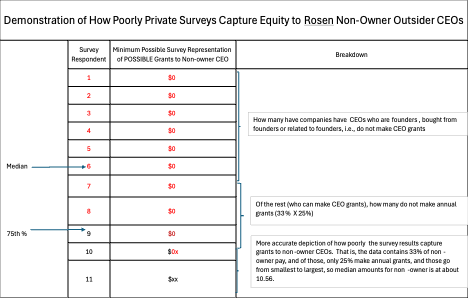
Now assume we go to a survey of private companies that reports annual grants to CEOs at various revenue levels. We’ll also consider no distinction is made in the LTI data for outsider vs. insider, but assume the participation of the outsiders is about a third. Let’s also make the generous assumption that one-quarter of the participating companies make annual grants of equity.
Under these assumptions, we won’t find annual grant amounts for nonowner outsiders at the median LTI level or even at the 75th percentile of the survey data.
In fact, we may not reach LTI data for the nonowner outsider until the 92nd percentile, at best—and even then, we’re only capturing the smallest equity grant. The median for the correct cohort would be at the 96th percentile!
That's the problem. Using conventional survey benchmarks without accounting for these differences can produce a dramatically understated picture of reasonable compensation.
The Solution in Reasonable Compensation Cases
So how do we resolve this conundrum?
The courts give us the answer by asking for a detailed assessment of all circumstances in the case, including particulars regarding the CEO's role and any relationship to the financial circumstances of the company. That is, a detailed review of the multiple relevant factors outlined in the cases, which will be the subject of a follow-on article.
P. Garth Gartrell is the founder of StreeterWyatt Analytics LLC, specializing in executive and board compensation analysis.